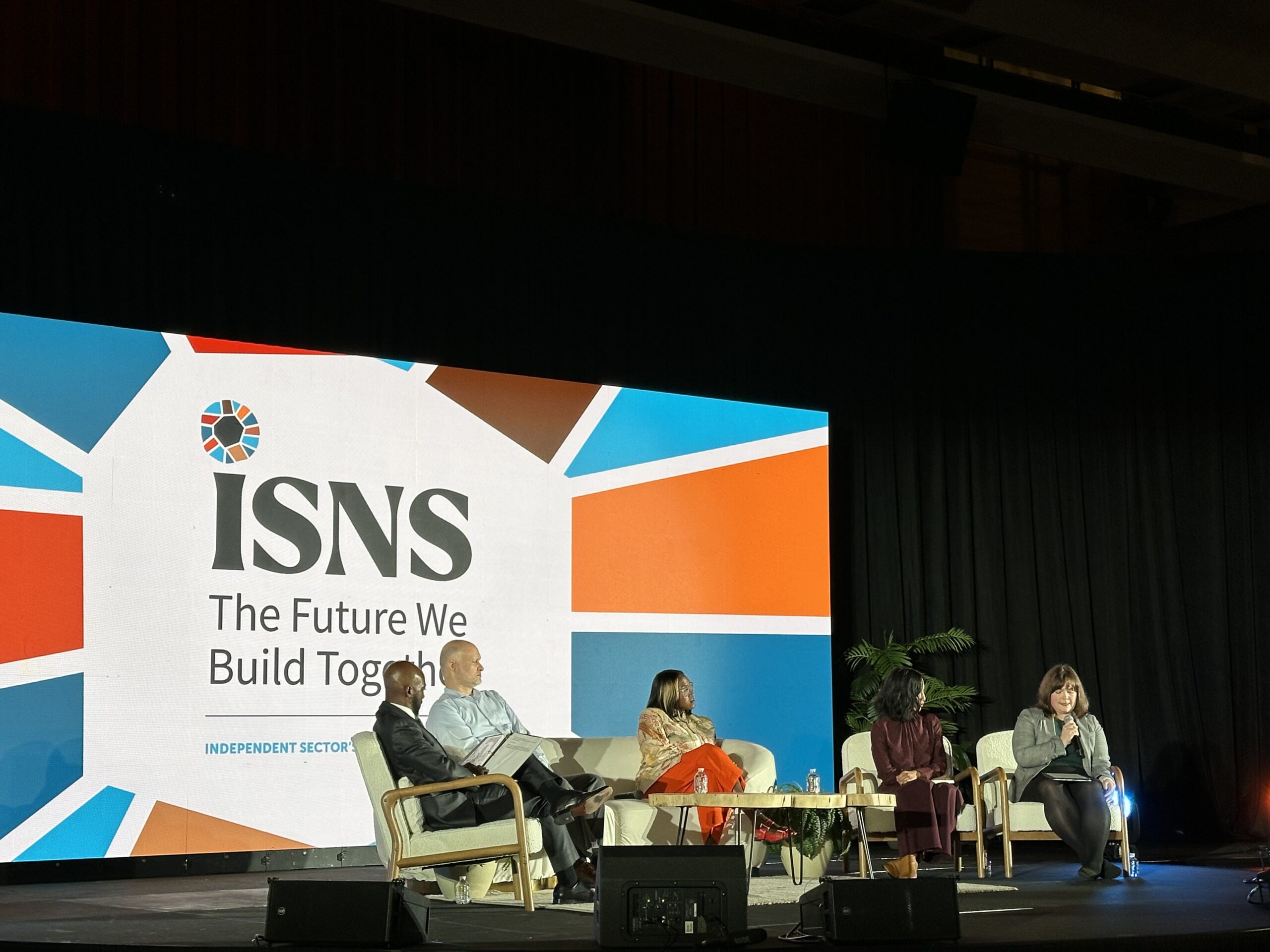
It’s been a 3 year absence for me at an Independent Sector-led annual conference, and I’m very happy to have returned for Independent Sector’s National Summit of 2026: The Future We Build Together. Below is a recap of some of the highlights. As with all of our posts capturing highlights of events, my interpretations, opinions, and additions of supplemental resources may be sprinkled in with the information provided by the presenters.
Independent Sector (IS) Board Member, Rev. Adam Russell Taylor, quoted Grandmaster Flash – “Don’t push me, ′cause I′m close to the edge” – in discussing the current state of the nonprofit sector and then cited Ted Lasso – “I believe” – in promoting his faith of the sector’s resilience and its organizations’ ability to advance their charitable missions.
Opening Plenary: The State of the Charitable Sector
Dr. Akilah Watkins, IS President & CEO
- Resilience isn’t simple – smaller nonprofits are focused on survival, not just their own, but also the communities they serve
- Needs of our communities have grown (e.g., consider loss of health insurance impacting millions, demand for nonprofit services has grown)
- Our sector is only as strong as our smallest and most vulnerable organizations – so the entire sector has a responsibility to support and step in – defending the sector involves halting harmful funding restrictions (e.g., those attacking DEI), and the sector has responded – nearly 500,000 comments on OMB proposed rule (see, e.g., NLIHC Submits Comments Opposing Proposed OMB Federal Grantmaking Rule; About 500,000 Comments Submitted)
- Public funding cuts are forcing nonprofits to take emergency measures – CEP Report – 36% of nonprofits reported reduced federal funding, >30% experienced state and local government funding losses, >40% are considering drawing from their reserves
- Growth in the nonprofit workforce is slowing despite increasing service demand; compensation is the leading reason why nonprofit workers leave (48% responded that this was a factor) – see 2026 Nonprofit Workforce Survey (IS)
- Health of nonprofit trust and governance – trust in nonprofits held steady (and it remains the most trusted sector in the U.S.), trust in philanthropy slightly dropped – interactions with nonprofits favorably impact trust – see Trust in Nonprofits and Philanthropy (IS); Public Trust in Nonprofits Leads Trust in Philanthropy by 27 Points (Eileen Hernandez)
- Advocacy as sector defense – more than 50% drop in the reported use of advocacy in the past 20 years – IS convened Panel on Advocacy, which contributed to the development of Guiding Advocacy Decisions: A Framework for Nonprofit Boards and Executives in a Dynamic Policy Environment (IS); IS also convened Panel on Nonprofit AI Use
- Due Process for Nonprofits Amendment (WIN!) – Taxpayer Assistance and Service Act – passed by the U.S. Senate – establishes a right to appeal for nonprofit audits and applications; requires IRS to provide notice of this right – see Senate Passes Bill Protecting IRS Due Process for Nonprofits (IS)
- Survey: Has the nonprofit sector met this moment? – The initial results – 55% said “No”
Plenary Panel
- There are lots of moments and components of moments, a great many nonprofits have been stepping up in some ways but systems (including those resulting in resource constraints) have prevented it from stepping up in other ways, but some nonprofits have not been stepping up to meet some of these moments for a variety of reasons | GT – We also have to remember the sector is not a monolith and there are nonprofits on every side of every major political and social issue, though the vast majority of nonprofits may be aligned on certain issues threatening the sector itself
- Not meeting the moment – getting sufficient funding, having financially healthy nonprofits (e.g., 2-3 years of reserve); increasing communication within the sector and with the public to better understand what is necessary for a healthy nonprofit
- Meeting the moment (what we should be doing) – making worker well-being fundable; focusing on the longer time frame for achieving gains; finding joy in the work
- National Fair Housing Alliance – “When we fight, we win” – but it’s so challenging for small nonprofits that may not have the resources to fight (joining coalitions may be less resource-intensive and politically risky, but they may still face loss of funding for taking positions)
- If nonprofits think it’s been tough so far, it’s only going to get tougher – consider building coalitions across ideological divides
- This is the moment to be the architects of the nonprofit sector, finding what is working right and doing more than that
The Final Two Years of Trump: Policies Driving Our Future
- 2026 legislative outlook (lame duck session after November elections and changes to Congress)
- Fund government – expires 12/11 (there are options that might delay this)
- Nonprofit provisions in OBBBA, including regarding charitable deduction floors
- Select tax proposals not included in final OBBBA could arise again
- Ways & Means-passed Digital Asset Tax Certainty Act (HR 10357)
- Reconciliation or bipartisan bills
- Sports tax issues
- Fiscal sponsorship bill – no companion bill on Senate side – so probably no legs
- 2026 IS Lame Duck Priorities
- Nonprofit Due Process Language – Taxpayer Assistance and Service Act
- Appropriations – OMB uniform guidance delay (keep funding extended)
- 2027 preparations
- Elections (mid-term)
- Senate – Ds could gain 3-5 seats but might not change R control (D need 4 seats to have majority)
- House – Ds need to net 4+ seats to flip House
- Unique races that don’t necessarily follow national trends – tension between moderates vs. more conservative or progressive as necessary to win
- Judicial branch may or may not uphold democratic principles related to fair elections – some nonprofits are prepared to protect the integrity of elections through the courts (Brian?)
- Expect more executive actions regardless of how the elections pan out (again, there will need to be reliance on the judicial branch and possibly, Congress)
- Damage may be done (nonprofits closing) at the cancellation of funding even if an executive action is overturned later by the courts or reversed
- Expect more redistricting by both parties in future elections
- Audience identified a broken democracy and electoral system not in service to the people
- Regulations
- Administrative priorities
- Introduced charitable legislation – expand IR charitable rollover to include DAFs; allow charitable rollover form other retirement plans (e.g., 401k plan); increase in charitable mileage rate; expand certain employment tax credits for nonprofit employers – small employer tax credit
- Income-based proposals from Democratic members
- Potential 2027 Policy Priority Areas
- Nonprofit workforce – employer tax credits, PSLF, workforce data (not collected on annual basis)
- Charitable giving incentives – corporate giving floor, 35% individual limit, retirement account giving
- Federal spending – overall spending levels, grant rules, rescissions
- Due process – audit and application procedures, defense of nonprofit independence
- Nonprofit civic engagement – voting rights, nonpartisan voter education and registration, Johnson Amendment
- Split Congress may make sector-wide priority areas those that have bipartisan support – nonprofit workforce, due process, civic engagement
- Republican-controlled House and Senate may make sector-wide priority areas focus on due process and federal spending
- Democrat-controlled House and Senate
- 990 instructions being written by White House not Treasury
Facts, Not Fear: Advancing Equity in Today’s Landscape
- READI (Racial Equity Advancement and Defense Initiative) – ABFE, AAPIP, NAP, HIP
- READI’s work promotes, expands, and defends race-explicit grantmaking and programming as essential tools for building a just and equitable society.
- We understand that the recent escalating political and legal attacks by right wing advocates are part of a long history of violence to discourage and eliminate efforts to create a truly inclusive, multi-racial, and multi-ethnic democracy. our goal is to prevent the rollback of racial equity efforts within the philanthropic sector and to ensure that investments aimed at addressing systemic racism and other forms of discrimination in communities of color continue to grow.
- READI Legal Support Fund (Tides) offers timely, flexible grants for legal counsel, security, and communications capacity so nonprofits centering racial equity can stay operational and responsive to their communities.
- Philanthropic Organizing
- Communications Narrative
- Field Education and Professional Development
- Lawyers Committee for Civil Rights: PADEI (Protecting and Advancing Diversity, Equity and Inclusion) – engages in legal, policy, and public education and outreach efforts to protect racial equity, diversity, equity and inclusion, and the rule of law, amid escalating attacks from federal and state governments and private actors.
- Pro bono legal assistance
- Fact sheets and resources
- Discussions of risks (legal, reputational, other)
- Robert Wood Johnson Foundation – Affirming Diversity, Equity, and Inclusion
- Has resources to sustain financial challenges
- Answering the Call for a Healthy, Inclusive Democracy – message from RWJF President
- General counsel reviews communications, activities, funding carefully
- Where do we want to take risk?
- How much risk is okay?
- What types of risk, including risks to communities served?
- Does the language describing solicitations or programs match what the organization is doing or prioritizing?
- Some funders may not give general support to avoid risks of supporting certain programs of grantee
Fireside Chat: Hispanic Communities Shaping American Democracy
- Maria Teresa Kumar, Co-Founder and President, Voto Latino Foundation, in conversation with Antonio Tijerino
- 30% of Latino eligible voters is under 30 [compare to 17% of white eligible voters]; over 50% of white eligible voters is over 50
- 2018 had largest turnout of voters to the polls and resulted in most diverse group of elected officials; 2022 (when voting restrictions had become a frenzy) saw a decline
- Sad fact but opportunity: so much of Gen Z Latinos are unaware of elections (Gen Z eligible voters outnumber Boomer eligible voters)
- Voter registration should be a government function
- When registration rates increase, polarization decreases
- But voter registration is viewed as political so it will likely go down (Gen Z does not like political parties)
- Communications are targeted to voters who have voted multiple times but younger persons may have just one or two elections in which they voted and consequently may not get communications about upcoming elections
- Double down on supporting organizations that do get-out-the-vote drives and voter registration drives and those that make younger persons aware of the upcoming election and why certain candidates and parties may better advance the interests of younger persons
Plenary: Protecting Independence, Preserving Impact
- Independence of associations has always mattered in the history of this country (predates its founding)
- Value of charity independence is critical to this country and to its residents
- Lack of awareness, understanding, and appreciation of the value of the sector (evidenced by data showing trending decrease in number of donors and failure to recognize personal interactions with nonprofits)
- Need independence of nonprofits to allow for creativity, experimentation, advocacy of communities that cannot and does not originate from the for-profit sector (driven by commercial market demands) or government (especially when the system is broken and driven by money and power)
- We all have a role to play in asserting the independence of nonprofits
- Collectively as a sector, nonprofits are closer to the community problems and solutions
- Public trust is critical; open communications of how to address threats is important; story-telling to show the value the nonprofit is bringing to its communities is huge
- Nonprofits should be driven by their missions and values in determining whether to take a grant/contract, tweak its mission, or change its goals
- The nonprofit sector is vast and diverse, but one value that is common across the sector is independence
- Independence – ability to do the things the organization wants to do in a bargain that others can also do the things they want to do (which may be in opposition to the values of the organization)
- Independence – ability and freedom for people to come together to find commonly-desired solutions
- Independence – allows for strengthened credibility and community trust
- IS helps create and protect the conditions to preserve the independence of the nonprofit sector
- The nonprofit sector has been under attack by the federal administration over the past 18 months (it’s been under attack by different administrations historically) – why should nonprofits that support the administration’s priorities now support the independence of the sector – because things change, administrations and their priorities change; demographics change; technology and tools change – independence matters today and tomorrow
- Threats to independence – HR 9495 – ability of Treasury to revoke exempt status for support of terrorism – but with government overreach and little protection against politically motivated revocations that are unrelated to any support of terrorism – there are better solutions to the problem of the misuse of charities for illegal purposes
- Solutions – audit risks (not just legal) and proactively protect against risks; communication practices matter (especially if less risk-sensitive organizations can be more vocal on behalf of more risk-sensitive and vulnerable organizations aligned in mission, values, and/or goals)
- Nonprofits can’t take their independence for granted; they need to remain vigilant, convene, collaborate, and advocate as a community
AI, Trust and the Future of the Charitable Sector
- Impact of AI usage on trust in the nonprofit sector
- Users of AI are substantially more positive about nonprofit AI usage than non-users of AI
- Some see AI as a path to operational efficiency
- AI bias and lost personalization create tension
- Transparency and human oversight are key to trust in nonprofit AI use (high agreement)
- 2026 State of Nonprofit AI Adoption and Governance Report – NTEN & Bridgespan Group
- Interest in AI has outpaced governance (use is happening without guidance)
- There have been harms as a result of AI use – data breaches, content integrity (e.g., misinformation), security issues
- Staff / executives have different AI adoptions and perspectives (e.g., 63% of executives somewhat or very positive compared to 39% of staff; 10% of executive somewhat or very negative compared to 33% of staff)
- Shadow use (borne of curiosity and lack of organizational guidance and policies)
- Clear needs: guidance and training (specific budgets – very low; but other guidance/training items – working on it)
- What will protect us from AI and its rapid development beyond safety guardrails? – Values
- Values – How and where do you already use your org values to guide governance, policy, and investment decisions?
- A fun group exercise responding to 3 questions and how we would classify them followed
National Awards Ceremony
- See Independent Sector Honors 2026 National Award Winners – congratulations to all the winners!
- Janet Murguía, President and CEO of UnidosUS, receives the John W. Gardner Leadership Award in recognition of her decades of leadership expanding opportunities and advancing civil rights for Latinos across the nation.
- Monica Nuvamsa, Executive Director of the Hopi Foundation, is this year’s recipient of the Janine Lee Mentorship Award, which recognizes outstanding mentorship in the charitable sector.
- John Fabian Witt, professor of law and history at Yale University, receives the Terry McAdam Book Award for The Radical Fund: How a Band of Visionaries and a Million Dollars Upended America.
Equitable Intermediaries: A Gamechanger Toward Achieving Equity
- Equitable intermediaries – group of organizations serving as fiscal sponsors in a manner that centers equity (disclaimer: includes several of our firm’s clients) – see, e.g., Equitable Intermediaries: Power, Protection, Partnership (Rank Gargione and Andrea Granda, NPQ); Equitable Intermediaries (Robert Sterling Clark Foundation)
- Core pillars of equitable intermediaries include: power, protection, partnership
- Fiscal sponsorship is an undervalued and under-resourced tool when done properly and driven by mission and values
- Fiscal sponsors absorb some risk for funders – funders and policymakers should understand that and provide greater support for the fiscal sponsors’ infrastructure (unrestricted funding)
- Review of fiscal sponsorship models A and C – both of which can be operated by an equitable intermediary
Plenary: Insights to Action: Building a Workforce for the Future
- Independent Sector Strategies: Advocacy (see Nonprofit Advocacy & Civic Engagement Research), Governance (see Principles for Good Governance), and Workforce (see Nonprofit Workforce Research)
- Who moves this sector forward in the future? Are we leaving them well-equipped?
- Top challenges: Well-being of workforce (burnout), pay and benefits, retention and recruitment, equity and inclusion, political disruptions to funding and attacks on the nonprofit sector
- Additional challenges: employee morale and engagement, volunteer morale and engagement, public perception, AI and technology, workforce development and training
- If thinking about workers, need to know about their needs and concerns – housing, health, etc.
- We know the things that need to be changed and sustained, we need to know how to implement changes
- Workforce development and training need to be normalized in nonprofit budgets
- Philanthropy workforce development issues are the same as with other nonprofits (including racial and gender wealth gap), but the difference is that philanthropy controls the wealth
- One other unique philanthropy workforce issue – employees should ask themselves what is working here doing to us (e.g., development of feelings of privilege)?
- Important for grantees to speak with funders about their workforce needs
- IS assessment tool; ultimately to help organizations benchmark themselves; IS will also identify resources to address the how and not just the what, translating the assessment into action
- Need more coalitions around workforce – organizations must approach this with some humility (you don’t know what you don’t know)
- Need more trust-based philanthropy
- Need funders to go out to grantees and ask them how their people are doing and figuring out how they can help
- Need to understand different elements of workforce health and pursuing progress on some elements
- Do an organizational climate survey, get employee feedback – make little changes, show you care about employees’ holistic well-being, turn it into story to share with funders (talk about workers all the time)
- Just start and think about what’s a good job
- Be open and curious to reimagine progress in this area
Closing
- Election coming – no matter the outcome, nonprofits have the opportunity to reimagine their relationship to government
- Future vision for the sector – financial resilience, health and growing workforce, influence on public policy matches its impact
- Upcoming IS events:
- November – advocacy training, documentary series – pilot
- December – 2026 health of the sector report
- January 2027 – independence of sector
- ISNS 2027 – Washington DC: Mission into Action – will include sector advocacy day (meeting with Congressional leaders and their staff)