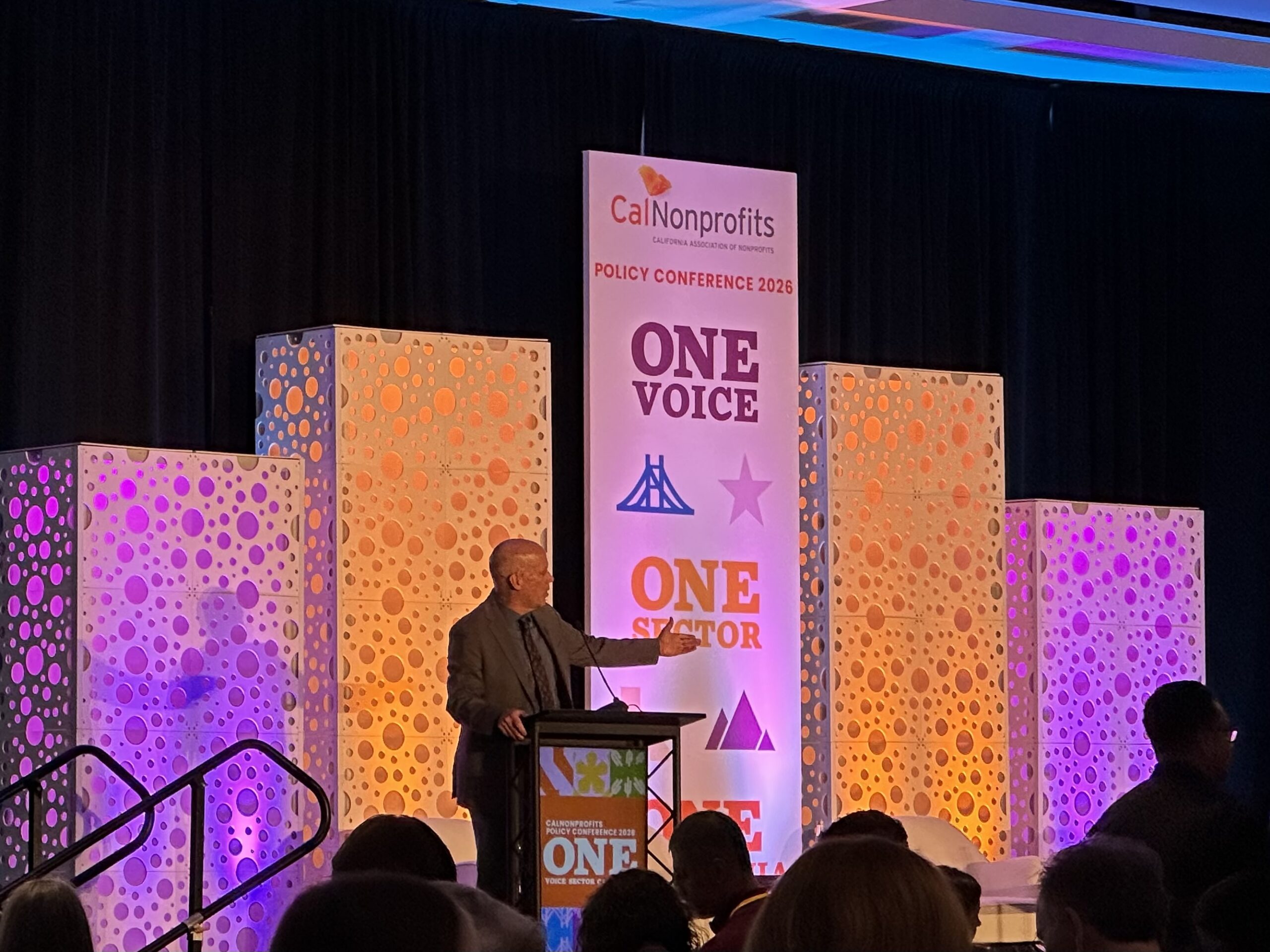
Below are some highlights from the 2026 CalNonprofits Annual Policy Conference held in Anaheim on November 17. The theme of the Conference: One Voice. The word of the day (based on attendee feedback): Hopeful.
As with all of our posts capturing highlights of events, my interpretations, opinions, and additions of supplemental resources may be sprinkled in with the information provided by the presenters.
At a moment of political uncertainty, economic pressure, and growing challenges to the nonprofit sector, this year’s CalNonprofits Policy Conference will focus on the power of collective action and a united nonprofit voice.
Please join nonprofit leaders, policymakers, funders, and advocates this November in Anaheim as we
- examine the post-election landscape
- explore new data on the sector’s economic and community impact
- discuss the strategies and partnerships needed to strengthen California’s nonprofit infrastructure and civic voice.
Through conversations on advocacy, coalition-building, technology, philanthropy, and public policy, we’ll focus on how nonprofits can build power together in the years ahead.
Post-Election Briefing and 2026 Legislative Recap for Nonprofits
- Not a mandate for Democrats; it’s an opportunity to meet the moment and address needs of working families
- To defend democracy, never give in – campaigns must reach out to segments not voting to same degree as wealthier populations – people of color and young persons
- Advocate to Governor-Elect, who may be more connected to the nonproft sector than our current Governor
- 14 state initiatives – voters approved about half
- See California Proposition Roundup: Results So Far (KQED)
- Prop. 40 (billionaires tax) discussion – some progressive orgs (e.g., Planned Parenthood) opposed in part because of one-time application rather than a durable progressive tax measure
- Voting Rights Act – U.S. Supreme Court has eviscerated – CA has gone the other way to make the protections part of state law (SB 1164 and SB 1360 signed into law on September 19, 2026) – see Governor Newsom Signs Voter Protections Into Law (League of Women Voters of California)
- Governor-Elect Becerra is committed to healthcare and health insurance – see Xavier Becerra is California’s next governor: Five things to know (CalMatters)
- CA SB 1288 – Win for nonprofits – includes provisions to help ensure financial institutions proactively notify non-probate beneficiaries (e.g., through retirement and brokerage accounts) – both nonprofits and individuals – so gifts reach their intended destination – see Governor Newsom Signs Legacy Fulfillment Act (CalNonprofits)
- CA AB 2221 – Win for nonprofits – includes provisions creating a “notice-and-opportunity to correct” framework, giving organizations a four-month window to fix clerical errors or filing issues before their “good standing” on the Registry is impacted – see California AB 2221: Delinquencies Redefined
- CA AB 2084 – Win for nonprofits – includes provisions to secure California’s authority to protect nonprofits’ state tax-exempt status when federal tax-exemption revocations unjustly target their speech, mission-driven activities, or viewpoints – see AB 2084 Safeguards Nonprofits Against Federal Threats (CalNonprofits)
- Disappointment for nonprofits – three bills vetoed by the Governor (despite near-unanimous, bipartisan support) offering straightforward, commonsense solutions to fix deeply inequitable state contracting practices that burden the nonprofit sector – see Newsom Vetoes Trio of Priority Nonprofit Bills (CalNonprofits); an additional bill vetoed by the Governor establishing establish the Office of Nonprofit Empowerment (ONE)—a centralized state-level hub giving nonprofits a dedicated voice in state government
Debate@ – DAF Payout Rate
- Jan Masaoka and Jeff Hamond had a spirited and civil debate on the issue of a mandatory DAF payout rate
- For criticism of the absence of a mandatory payout rate and need for philanthropic reform, see the Philanthropy Project website with its tag line “charitable funds should benefit the public” – match the tax benefit of the donor to the benefit to the public (when funds are released to a charity that has the practical ability to deploy the funds to advance charitable programs and activities and not act as an agent for the donor or their advisors in investing the funds without any requirement to make a distribution)
- For the perspective of a group of community foundations (many of which are principally DAF sponsoring organizations), see Community Foundation Awareness Initiative – don’t rock the boat where the distribution rate is much higher than the required minimum distribution rate of private foundations (i.e., 5%) and could possibly signal to donors to recommend smaller donations or not make locked-in donations for charitable purposes at all
Breakout: Protest, Documentation, and Dissent: Nonprofit Roles in Upholding Constitutionally Protected Rights and Advancing Democracy
- Nonprofits are vital in advancing our democracy
- Civil rights are not self-enforcing; they rely a great deal on nonprofits willing to fight
- ACLU – engaged in defensive rights protection; and proactive rights advancements
- SoCal – canary in coal mine since second Trump administration – e.g., ICE; community protested and continues to protest; organizations and advocates stood up, including through litigation; administration brutalizes journalists; authoritarian playbook; key – “remain vigilant”
- Attacks are not limited to nonprofits but are targeted on every person or organization or movement doing things contrary to the administration’s priorities and goals; attacks are also coming from other nonprofits (e.g., progressive nonprofits may face attacks from conservative nonprofits like the Heritage Foundation and Federalist Society)
- Form sof attacks:
- Canceling government contracts (#1)
- Attacking DEI using civil rights laws
- Creating a culture of fear mostly though the threat of action rather than actual action (but funders and charities have changed behavior due to fear based on threats)
- SPLC – prosecution of nonprofit without much legal merit
- Elections do not necessarily shift legislative and public opinions on the need for ICE; anti-Trump movement is not identical to pro-Democratic principles; e.g., Supreme Court reform necessary (e.g., Bivens)
- Need to wait until elected officials are seated; there are still abuses going on with incumbents
- Many candidates who won and who represent themselves to be be pro-democracy need to be held accountable
- Important for citizens and residents to be documentarians (e.g., with phone cameras)
- Need to enforce state Voting Rights Act
- Solution – broad judicial reform
- Threat of AI on 2028 elections
- Threat of money on politics – but also power of people over money (e.g., TX)
- See Keeping Our Republic: The Roles of Charitable Nonprofits (National Council of Nonprofits); Democracy and Rule of Law (Ford Foundation); How Nonprofits Are Resisting Trump’s War on Immigration at the State Level (Alliance for Justice)
Keynote – California Attorney General Rob Bonta
- 102 lawsuits against the federal administration – see “A Sobering Milestone”: Attorney General Bonta Files 100th Lawsuit Against the Trump Administration in Under Two Years (Office of the Attorney General) – winning 80% of the time – will continue to sue on any issue where the federal administration is engaged in illegal activity
- Some nonprofits have led lawsuits against the federal administration; some have filed amicus briefs; some of educated the public and advocated on the issues; some work with the government to provide a safety net for those in need
- See Attorney General Bonta Celebrates Ninth Circuit Ruling Upholding Order Against President Trump’s Unlawful and Unconstitutional Federalization of California National Guard (Office of the Attorney General)
- AG had to plan carefully to protect votes against hostile federal administration.
- Almost 90% of Californians vote by mail, and the federal administration tried to attack election process
- Even post-election, Bonta expects continuing attacks on the election process by the federal administration
- True enemy of democracy is apathy
- AI is a concern – great opportunity for good and huge opportunity for risk (Bonta – “you can be innovative and safe”) – See, e.g., California sues OpenAI over hacking risks (NPR)
Legislator Keynote – Sen. Jerry McNerney (Chair, Senate Select Committee on the Nonprofit Sector)
- Legislators will respond more to collaborative advocacy with a unified plan
- SB 1240 (Office of Nonprofit Empowerment) – passed with near unanimous legislative support but vetoed by Governor – See Take Action: Support a New State Office for Nonprofits (CalNonprofits)
- GO-Biz (Governor’s Office of Business and Economic Development) available for for-profits; nonprofits left out
Keynote – Glen Galaich
- For the wealthy, making a contribution requires some benefit in return
- Until 1969, private foundations had no minimum distribution requirement
- Foundation staffing all focused on the 5% of assets to be distributed and not on the remaining 95% of foundation assets
- The 95% is being put into investments, many of which create substantial harm to the communities the foundation purports to serve
- Charitable funds should remain spent on and invested in charities
- Fake law – foundations need to be there forever
- One policy to advocate – no full charitable contribution deduction until it is spent out of a private foundation or donor advised fund (query – what about endowment gifts to private schools, universities, and other public charities?)
- Galaich’s book – Control: Why Big Giving Falls Short – focuses on culture rather than policy change (since the former is more likely to mobilize foundations and their war chests)
- Should foundations prioritize compounded interest in endowments or compounded impact in the hands of their grantees?
Closing
Save the date for the 2028 CalNonprofits Policy Conference back in Anaheim on Tuesday, November 9. I plan to be there! Nothing like being in community with others and feeling the vibe of an engaged group of nonprofit leaders.
Shout out to CalNonprofits for another great Policy Conference! So good to see Geoff, Jan, Jennifer, Susie, Karl, May, Casey, and many others!
For my recap of last year’s conference where I had the privilege of delivering a keynote presentation with the brilliant Rosemary Fei, see 2025 CalNonprofits Policy Conference Supplement [W]Rap (which includes the words to my undelivered nonprofit take on Kendrick Lamar’s They Not Like Us).