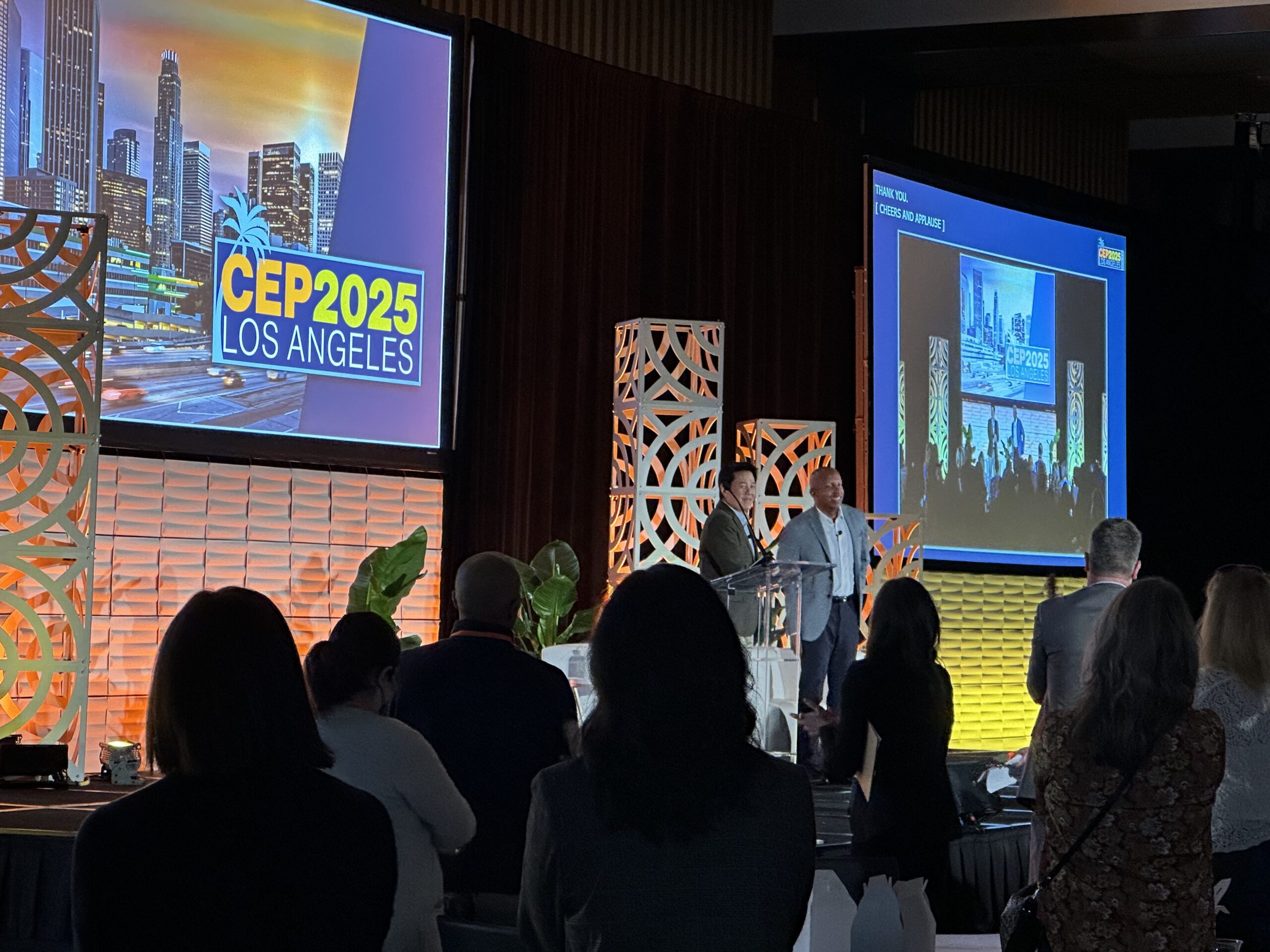
The biennial Center for Effective Philanthropy (CEP) conference was held in Los Angeles this year from November 3 through November 5. The conference attracted some great speakers and touched on many of the critically important issues facing philanthropy and the grantees, causes, and communities philanthropy supports. Here are some of the highlights with some additional resources and thoughts:
Plenary: Civil Society Under Threat
Nonprofits, funders, and other civil society organizations worldwide face an unprecedented array of challenges and threats to their ability to operate effectively and fulfill their missions. From increasing government scrutiny and intimidation to severe cuts to government funding to declining public trust and rising polarization, civil society faces existential challenges around the globe. Against this backdrop, how are philanthropic funders and nonprofit organizations responding? What strategies are proving most effective in protecting and strengthening civil society’s essential role?
The opening plenary introduced a new CEP Report: Mounting Pressure: U.S. Foundations and Nonprofits on the 2025 Political Climate. The following are just some of the many findings:
- 34% of nonprofits experienced losses, 22% anticipate losses from the federal government
- 29% of nonprofits experienced losses, 30% anticipate losses from the state/local government
- 46% of nonprofits respond that they have a concern about the risk of their organization needing to close or merge
- 35% of nonprofits experienced losses and 27% anticipate losses from foundations
- 30% of nonprofits experienced losses and 23% anticipate losses from individuals
- 29% of nonprofits experienced reductions in staffing, 23% anticipate it
- 35% of nonprofits have concerns about well-being/safety of staff/board, 13% anticipate having such concerns
- 81% of nonprofits have experienced or anticipate experiencing increased demand for services
- 60% of nonprofits initiated collaborations/partnerships with other nonprofits
- 61% of nonprofits say that the current context poses moderate to significant risk for them to continue to operate
Plenary: Philanthropy’s Role in Building Strong Institutions for a Changing World
In an era marked by declining trust in institutions—from government agencies and nonprofits to schools, hospitals, and civic organizations—it’s tempting to write them off as outdated or ineffective. Whether addressing education, climate change, housing, or any other pressing societal challenge, the effectiveness of philanthropic work ultimately depends on the health of the institutions that undergird our communities. This is surely true for Los Angeles, which faces the convergence of multiple pressures: infrastructure needs, climate resilience, housing shortages, and the recent devastating wildfires. Add to these broader national tensions related to immigration enforcement, and the question becomes even more urgent: How can philanthropy, government, and business work together effectively to bring positive change? This session will examine these fundamental questions drawing lessons from Los Angeles while offering insights applicable to funders regardless of their issue areas or geographic focus.
- Three big questions for philanthropy: (1) What is right of the use of power? (2) What is the social compact? (3) How do we strengthen social cohesion and trust?
- Focusing locally may provide the greatest impact during times where the federal government and many state governments are hostile to the nonprofit sector and many of its critical segments.
- Los Angeles County is the biggest county in the country with a similar population to the state of Michigan. On certain issues like addressing homelessness, the vast majority of funding comes from the government, so foundations may be most effective in supporting local governments to be more effective in their support.
- At the same time, foundations must listen to the communities they serve. When those communities call on philanthropy to spend more money, their trust in foundations will be based in large part on how foundations respond to this call.
- We must focus more on trust-based, human-centered grantmaking. Heart-centered, not data-centered. This will open up co-creation opportunities.
- Bridging is important. Values should not be a litmus test for who we work with. And we need to get to the material and economic reasons for our divisions in order to make bridging effective. However, this does not mean that we have to attempt to bridge with those who are trying to kill us. Further, we must understand that building deeper trust with grantees and communities is a generational project, and foundations must approach this with a longer time-horizon.
Plenary: Ezra Klein on Philanthropy’s Role at a Precarious Time
Why does progress feel so hard to achieve in America today? In his new book “Abundance,” co-authored with Derek Thompson, New York Times columnist and podcast host Ezra Klein argues that liberalism has forgotten how to effect policies that tangibly improve peoples’ lives, from building affordable housing and infrastructure to implementing climate solutions that make affordable, clean energy more available. Klein contends that America needs to renew a politics of plenty, face up to the failures of liberal governance, and abandon what he calls the chosen scarcities that have deformed American life. But what does this analysis mean for philanthropy, particularly at a moment when the sector faces its own questions about effectiveness and political positioning?
- The plenary was also on a live podcast of Giving Done Right.
- Many powerful actors within civil society have been a major disappointment in response to the federal administration (e.g., Tim Cook, Jeff Bezos, Mark Zuckerberg, Republicans in Congress giving up spending power)
- Trump tests boundaries and is finding many boundaries that are not firm; the guardrails [of our Constitutional democracy] are not holding and are disappearing
- It is at such times when there needs to be more bravery from leaders of civil society and from Americans who (1) believe they do not have to risk anything and can stay quiet while having democracy and freedom and (2) fail to heed the lesson from Frederick Douglas: “If there is no struggle, there is no progress”
- The stakes (and risks) are high but not historically unusual and not compared to many other parts of the world; the idea that this is profoundly unusual is not true
- What has changed: the digitalization of politics has created a herding and enforcing of public opinion, which has then filtered back into political culture
- The Left needs to recognize it failed and allowed authoritarianism to rule; its political gains since 2012 have been only to move the Democratic party more to the left and achieve a demographic gain among young white male voters; to advance democracy, it must make sure more people feel liked and respected by those on the Left (people won’t vote for a party they feel doesn’t respect them); it is failing in the politics and coalition-building, but this can change – see, e.g., Opinion: This Is the Way You Beat Trump — and Trumpism (NY Times)
- The Right is vulnerable as it has been alienating a lot of voters (e.g., pro-Hitler Nick Fuentes) and relying on a call for unconditional support rather than belief in its priorities and actions
- We need a change in the culture now when it really matters; nihilism and passivity are a sin
Plenary: Immigration, Migration, and the Future of America
The recent ICE raids across Los Angeles and throughout the United States have sparked widespread protests and renewed urgent questions about America’s response to increased immigration. Yet these current events cannot be understood in isolation from the longer arc of American history. How do we make sense of this moment, and what does it mean for the future of a nation built by immigrants and refugees? Grounded in historical insight from a leading expert, this session will equip philanthropic leaders with both meaningful context and a strategic lens on this pressing issue.
History from Kelly Lytle Hernández (UCLA)
- Haitian Revolution (1791-1804) – Enslaved majority in Saint Dominique revolted; many fled North to America; some of America’s founding fathers feared the revolution; few of the country’s leaders were abolitionists at that time and the majority feared abolition; this resulted in the first immigration bans (state laws)
- Most states banned Black migration before the Civil War, but not until the Civil War was there the federalization of immigration control
- Chinese Exclusion – California discriminatory laws challenged after passage of the 14th Amendment in 1866 (equal protection). 14 extraordinary women brought a case which went before the Supreme Court and won (based on a federalism argument) – Chy Lung v. Freeman (1875). Yet, this was at a time when Supreme Court Justice Stephen Field expressed: “You know I belong to the class who repudiate the doctrine that this country was made for the people of all races. On the contrary, I think it is for our race-the Caucasian race.”
- Chae Chan Ping v. U.S. (1889) federalized immigration control (equal protection only applied to the states and not to the federal government)- applies the plenary doctrine to immigration exclusion (plenary power is not subject to court review) and refers to “an Oriental invasion”
- Fong Yue Ting v. U.S. (1893) – extends the plenary doctrine to deportation – but Justice Field dissented – “Court has created a dangerous and despotic power” (precedent for today)
- Wong Wing v. U.S. (1896) – immigration detention is “not imprisonment in a legal sense” – applies plenary doctrine to immigrant detention same day as Plessy v. Ferguson (separate but equal case)
- Yamataya v. Fisher (1903) – also referred to as the Japanese Immigrant Case – requires administrative hearings for all immigrants facing deportation – but note that no due process rights for alternate forms of “deportation” so this decision only provided a very thin line of protection
- How many people have been deported since 1892? – More than 50 million (the U.S. is a nation of deportees)
- Whites-Only Immigration System – not to keep out all who were not-white, but a system of racialized power – guestworker program brought migrant workers from Barbados to the Panama Canal zone (1905-1914); eligibility restrictions – “Asiatic Barred Zone” – literacy test – banned eligibility to naturalize; visa regime (1924 Johnson Reed Act – cut Black migration 1924-1945 by over 90% – criminalization of undocumented border crossings (Canadians can legalize, aimed at Mexicans)
- To this date, this system has been amended but never abolished; it’s still a racist system – 1965 Congress did not ban racism in Visa eligibility by race and national origin – Latinos continue to be the target; 1975 Brigononi-Ponce v. US (ICE can stop people solely based on their appearance of race/ethnicity) – racial profiling – South Afrikaners today favored
- The country’s system remains racist, dangerous, despotic
- One of the longest social justice campaigns in our history is still ongoing – it is the center of the unfinished freedom story of this country
- We must fund more than emergency responses; philanthropy must recognize this crisis of democracy and racism in America
- See also The Whites-Only Immigration Regime lecture (Huntington)
Panel discussion
- Angelica Salas (ED, CHIRLA) – we could never come in the front door, we could only come in through the back door (lived experience) – the history is not just the history of exclusion, it’s the history of fighters for their rights – #1 issue – legalization of 14 million people in this country without status because they are denied basic rights and due process (they are “hunted down”) – 1986 amnesty program was a sign of hope – let’s update the Registry Act (updated to 1972) – bring it closer to the present with a rolling mechanism – most people kidnapped and deported have been here 20-30 years – call to funders: invest in the people who are going to save our democracy, including our immigrant workers – unite in your power and ask what you can do collectively to support immigrant communities and our democracy
- Julián Castro (Latino Community Foundation) – time to be bold and lead as funders, including of mental health – strategic narrative change work is necessary for policy change (note the impact of the ICE videos) – people are fundamentally good and want to be kind and compassionate, but need to act on this
- Myal Greene (World Relief) – great reduction in humanitarian protections (asylum) and now preferences for white Afrikaners; Haitians with legal status removed now – 10-11x increase in the budget for immigrant detention (compensating companies that detain people) – must dispel misunderstandings of who is being detained (it’s mothers and children, not criminals) – have courage and step out in this moment, do something hard and think about whose lives are really at stake
- Brenda Solórzano (California Endowment) – strategy on plenary power – will take a generation or two – hellraisers, abolitionist, fighters – be brave – we are the ancestors of our descendants and consider what your descendants will say about you
Closing Plenary: Moral Leadership for This Moment
What does moral leadership look like in a time of profound division and crisis? How do we maintain hope while confronting hard truths about injustice and inequality? Bryan Stevenson, founder and Executive Director of the Equal Justice Initiative, has spent his career answering these questions through contemplation and action. Over three decades, he has won relief for more than 140 wrongly condemned prisoners on death row, secured landmark Supreme Court victories protecting vulnerable populations, and created institutions like the Legacy Museum and National Memorial for Peace and Justice that force America to reckon with its history of racial violence and mass incarceration.
- Stevenson’s powerful storytelling conveyed more than the few lessons highlighted here – see, e.g., Alabama’s Legacy Museum Tells The Story Of Racial Injustice (Essence)
- At the time he graduated from Harvard Law School, Stevenson felt that the rule of law would protect the rights of marginalized persons, but now, he knows that you can’t just depend on the rule of law
- This is the first time in Stevenson’s life when the Supreme Court seems hostile to civil rights; he suggested that Brown v. Board of Education might have been decided differently if it were before the Court today
- Now, the priority is proximity, to get close to those vulnerable, harmed, and suffering; if that shapes our judgment, we can meet this moment
- The other priority is changing the narratives – while civil rights laws have changed things for the better, the underlying narratives that supported slavery and other racist laws have in many ways persisted and are now spreading like a virus
- Fear and anger are still used to shape policy and get people to tolerate and accept things they wouldn’t otherwise; too many of us are silent about this evil
- Changing the narrative will take a major investment in truth and justice; flexibility is also required in a rapidly changing environment; Stevenson – “We deny ourselves the beauty of justice when we refuse to tell the truth”
- Further emphasizing that changes in law are not enough, Stevenson discussed the 1965 Voting Rights Act and said it would have been more appropriate to also remedy the disenfranchisement of Black voters (e.g., registering them after the Act was passed) because states just found new ways to disenfranchise them – this would be consistent with how the law provides for remedies when there are violations of law; remedies should be part of the established system
- We need moral courage – we need to articulate our values more, putting aside the challenges and emphasizing who are we and who we want to be
- You can’t say that you would have been an abolitionist or marched with Dr. King back in the day if you’re not doing the hard things now
- We dishonor our ancestors when we lose courage of seeing something better than what we see – we need to be lifted up by that – I stand on the shoulders of people who did so much more with so much less – I will not dishonor them at this moment – I owe them too much – we owe them too much
My Big Picture Learnings
This hostile political and legal environment to so many nonprofits is not new; others, including our ancestors have dealt with worse, had less, and admirably advanced their causes, giving many of us a sense of false comfort.
This is a time to continue to fight strategically for the causes we believe in and to keep our eyes not only on singular issues of importance, but also on the big picture. We must embrace our common values and not exclude everyone who disagrees with some of those values, especially if that results in more harm to the communities we’re trying to protect. Changing minds can take time and is made especially difficult in a polarized society addicted to digital culture.
Setbacks that harm so many people are awful, but if we look at our world’s history in bigger blocks of time (e.g., 50-years), we may still be encouraged and fueled by the advancements made for a great majority of the world’s population while recognizing that the long moral arc of justice is not smooth but consists of myriad ups and downs even as it bends upwards.
The work needed is continual. And the need never abates. There will always be challenges – some of them absolutely horrendous. But there is no giving up. Stevenson states that he owes it to our ancestors to continue and that we all do.
Additional Resources About the Conference from CEP
Grounded in Data: Day One of CEP2025 (Chloe Heskett)
‘The Light Is Already On’: Day Two at CEP2025 (Chloe Heskett)
A Perilous Moment in the ‘Long Arc’: Day Three at CEP2025 (Chloe Heskett)